Choose a gas grill if you cook outdoors often, want serious searing heat, and have a safe, well-ventilated spot for a propane tank. Choose an electric grill if you grill on a balcony, live where open flames are restricted, or simply want push-button starts and a five-minute wipe-down. That is the decision in two sentences; the rest of this guide explains why it holds and where it can be broken.
A gas grill burns propane or natural gas at one or more burners. The flame heats metal bars, ceramic tiles or an infrared screen, and that hot surface radiates down onto the cooking grates. An electric grill turns mains electricity into heat through a sheathed metal element or an infrared lamp, with no combustion at all. Both cook food over a hot grate, and almost every practical difference between them follows from that one distinction.
For outdoor cooking, three things decide more than brand or price: where the grill is allowed to sit, how much heat the food actually needs, and how much fuel logistics you will tolerate.
Gas vs Electric: The Differences That Actually Matter
Gas wins on heat and speed; electric wins on placement, ignition and cleanup. Typical figures sit side by side below.
| Factor | Gas grill | Electric grill |
|---|---|---|
| Heat source | Propane or natural gas flame | Sheathed element or infrared lamp |
| Typical heat output | 8-15 kW (27,000-50,000 BTU/hr) | 1.6-2.4 kW (5,500-8,200 BTU/hr) |
| Preheat to 230 °C | 8-12 minutes | 12-20 minutes |
| Peak grate temperature | 260-320 °C, higher over an infrared sear zone | 200-260 °C |
| Fuel and logistics | Refill a 9 kg (20 lb) tank every 10-15 cooking hours | Plug into a grounded outdoor outlet |
| Running cost | About USD 2-3 per hour at medium heat | About USD 0.25-0.40 per hour |
| Placement rules | Often banned on apartment balconies; needs roughly 3 m clearance | Usually allowed on balconies with a suitable outlet |
| Cleanup | Grease tray, burner tubes, flavorizer bars | Grease tray and an element wipe-down |
| Best fit | Family cookouts, steaks, burgers, large batches | Small patios, rentals, weeknight meals for 2-4 |
Three Questions to Answer Before You Compare Specs
Answer these first, because a single "no" can eliminate one type entirely, however good its spec sheet looks.
1. Is there a safe, legal place for a fuel tank?
Gas grills need a propane cylinder stored upright outdoors, plus roughly 3 m (10 ft) of clearance from walls, railings and anything combustible. Many apartment and condo rules ban open flames on balconies outright. If your only outdoor space is a covered balcony above a neighbour, the choice is made for you.
2. How many people are you feeding?
One to three people are well served by a compact electric grill or a portable gas model in the 350-450 square inch range. Four to six need roughly 400-600 square inches and enough power to hold temperature with the lid open. Above six, gas with three or more burners is easier, because a single electric element rarely recovers heat fast enough for back-to-back batches.
3. How often will you actually light it?
Frequent cooks usually prefer gas: instant ignition, high heat on demand, no cord. Occasional cooks often do better with electric, since there is no tank to run dry before a spontaneous dinner.
Heat, Searing and Flavor: What Each Grill Can Do
Gas grills sear; electric grills cook. If a dark crust on a steak matters to you, gas is the more forgiving tool.
A three-burner gas grill in the 10 kW range pushes the grate past 300 °C within ten minutes and recovers quickly after you open the lid. Infrared sear burners go further, driving the grate surface several hundred degrees higher for 60-90 seconds per side, which is what creates a steakhouse crust. The trade-off is that gas heat is dry and aggressive, so thin fish fillets and delicate vegetables need a lower setting and closer attention.
Electric grills plateau earlier, typically between 200 °C and 260 °C. That is still enough for chicken thighs, sausages, burgers, corn and skewers, and the steady heat is easier to control. What you will not get is a hard sear or the smoky edge that comes from fat hitting a flame. In exchange, there are no combustion by-products, which makes an electric grill simpler to use in a sheltered spot.
Running Costs and Fuel Logistics
Electric is cheaper per hour; gas is cheaper per unit of heat. The difference shows up mainly in how you buy fuel.
A standard 9 kg (20 lb) propane tank holds roughly 430,000 BTU. At a medium setting of about 30,000 BTU/hr that is 12-14 hours of grilling; with every burner wide open it falls closer to eight. A refill typically costs USD 20-30, or roughly USD 2-3 per cooking hour, plus a spare tank if you dislike running dry mid-barbecue.
An electric grill that draws 1.8 kW uses 1.8 kWh per hour. At USD 0.15 per kWh that is about USD 0.27 per hour, so a three-hour session costs under a dollar. The catch is the outlet: you want a grounded outdoor socket and a cord rated for outdoor use and heavy enough for the load. A long, thin extension cord on a 13 A grill will trip the breaker or overheat.
Safety, Site Rules and Everyday Placement
Never use either grill indoors, in a garage or under a tent. Gas adds a second hazard, because carbon monoxide is odorless and builds up quickly in any covered space.
Grill outside with the lid open at startup, keep at least 3 m between the grill and walls, fences and overhanging branches, and never store a propane cylinder indoors or in a hot vehicle. Check hoses and regulators for cracking each season and leak-test connections with soapy water, never a flame.
Electric grills remove the combustion risk but not the electrical one. Use a grounded outdoor outlet, keep the control panel dry, and never run the cord across a walkway. For renters and balcony cooks this is often the deciding factor: an electric grill is welcome in plenty of places a gas grill is not.
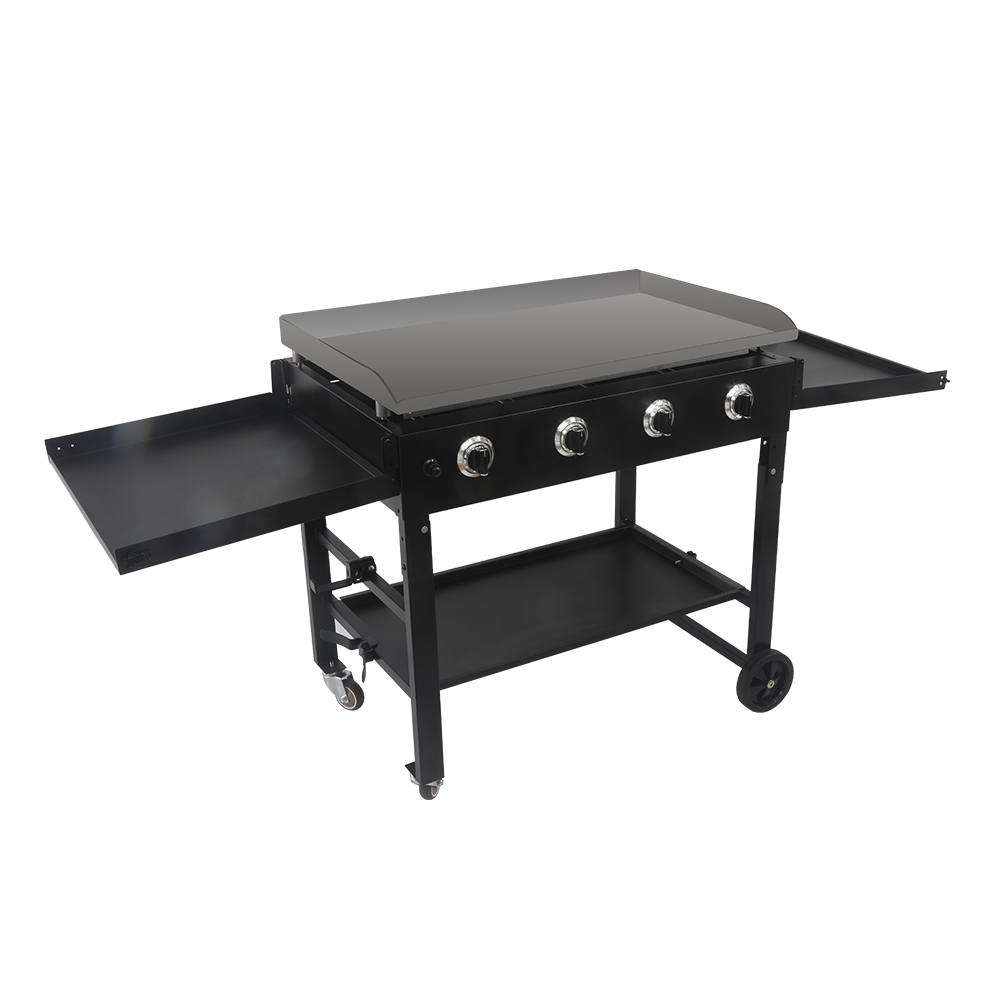
 Portable Propane Gas BBQ Grill with Four Burners and Collapsible LegsA propane/LPG portable gas grill with four burners, a spacious iron plate, side-flip lid, and collapsible legs; gas grills need routine burner care.View Product →
Cleaning and Long-Term Ownership
Electric grills clean up faster; gas grills need more routine attention but last just as long when the burners and drip tray stay clear.
With gas, burn off residue on high for ten minutes after cooking, brush the grates while they are still warm, empty the grease tray before it overflows, and check that burner ports are not clogged with grease or insects. Grates and flavorizer bars wear first, so confirm they are replaceable before you buy. A detailed routine is set out in this guide to cleaning and maintaining an outdoor BBQ grill.
With electric, unplug the unit, let it cool, wipe the element housing with a damp cloth and wash the drip tray. No ash, no soot, no gas line to inspect.
What to Check on the Spec Sheet
Ignore the marketing bullets and check six things: cooking area, grate material, power, ignition, weight and spare-part availability.
| People served at once | Cooking area | Typical format |
|---|---|---|
| 1-2 | 200-350 sq in | Portable or tabletop electric |
| 3-4 | 400-600 sq in | Two to three burners, or a mid-size electric |
| 5-6 | 600-800 sq in | Three to four burners with a side burner |
| 7 or more | 800 sq in and up | Four or more burners, cart or built-in |
- Grates: cast iron holds heat best, stainless steel resists rust, porcelain-coated steel is the budget compromise.
- Power: aim for 2.5 kW per gas burner, or 1.8 kW and up for a full-size electric grill.
- Ignition: push-button or electronic ignition saves a lot of fiddling with a lighter in the wind.
- Weight: a full propane tank adds 15-20 kg, so lockable casters matter more than you expect.
- Spares: if the maker lists no replacement burners, elements or grates, treat the grill as disposable.
Frequently Asked Questions
Can an electric grill sear a steak?
It can brown one, but a true dark crust is hard to reach because most elements top out near 260 °C. For steakhouse searing, gas with an infrared burner is more reliable. If you mostly cook chicken, fish, vegetables and burgers, the gap matters far less.
Which is cheaper to run, gas or electric?
Per hour, electric almost always wins at roughly USD 0.27 against USD 2-3. Per unit of heat, propane is often cheaper, which is why large gatherings still favor gas. If you grill twice a month for two people, the annual difference is trivial.
Are electric grills allowed on apartment balconies?
More often than gas or charcoal, because there is no open flame. Rules vary by building and city, so check the lease, the HOA documents and local fire codes first, and confirm you have a grounded outdoor outlet.
How long should a grill last?
With a cover, regular cleaning and parts replaced as needed, five to ten years is realistic for both. A gas grill asks more of you, since hoses, regulators and burners are consumables; an electric grill's wear items are the element and the control board.
The Short Verdict
Buy gas if you grill year-round, cook for a crowd and want a hard sear, and you have an open, legal spot for a tank. Buy electric if your outdoor space is small, shared or rule-bound, or if convenience and easy cleanup outrank char. If you are genuinely torn, a hybrid grill that combines a gas burner with infrared and a griddle plate covers both cooking styles on one cart, which is often the cheapest way to stop guessing.